There is one habit that separates local businesses that win enquiries from businesses that lose them, and it has nothing to do with price, quality, or how good the Instagram grid looks. It is how fast they reply.
Why does the first business to reply win?
The first business to reply usually wins the customer because most people enquire with several businesses at once and book whichever one answers. They are not choosing the best salon or the cheapest plumber. They are choosing the one that responded while the problem was still front of mind.
Put yourself in the customer's position. It is 8pm, their hot water system has died, and they have messaged three plumbers. They are anxious, they want the problem handled, and the first reply that says "yes, we can help, here's what happens next" gets the job. The other two replies, arriving the next morning, land in a decided situation.
This is why widely cited lead-response research puts the share of customers who buy from the first responder at around 78%. The exact number varies by study and industry, but the direction never does: speed beats almost everything else a small business can control.
How fast is fast enough?
For a local business, "fast enough" means minutes when you are open, and an instant automated response when you are not. Studies of lead response times consistently find that the odds of connecting with an enquirer collapse within the first hour, and most enquirers have moved on well before a next-day reply arrives.
The uncomfortable part is that nobody tells you when you have lost. The customer who booked elsewhere does not message back to say so. The enquiry just goes quiet, and the silence looks identical to a tyre-kicker. This is why slow-replying businesses rarely feel the problem: the losses are invisible. We covered the same effect from the website side in the 7 questions your website must answer by 9pm.
How can you reply faster without living in your phone?
You can cut your average reply time dramatically with two habits that take less effort than what most owners do now, which is glancing at their phone all day and still replying late.
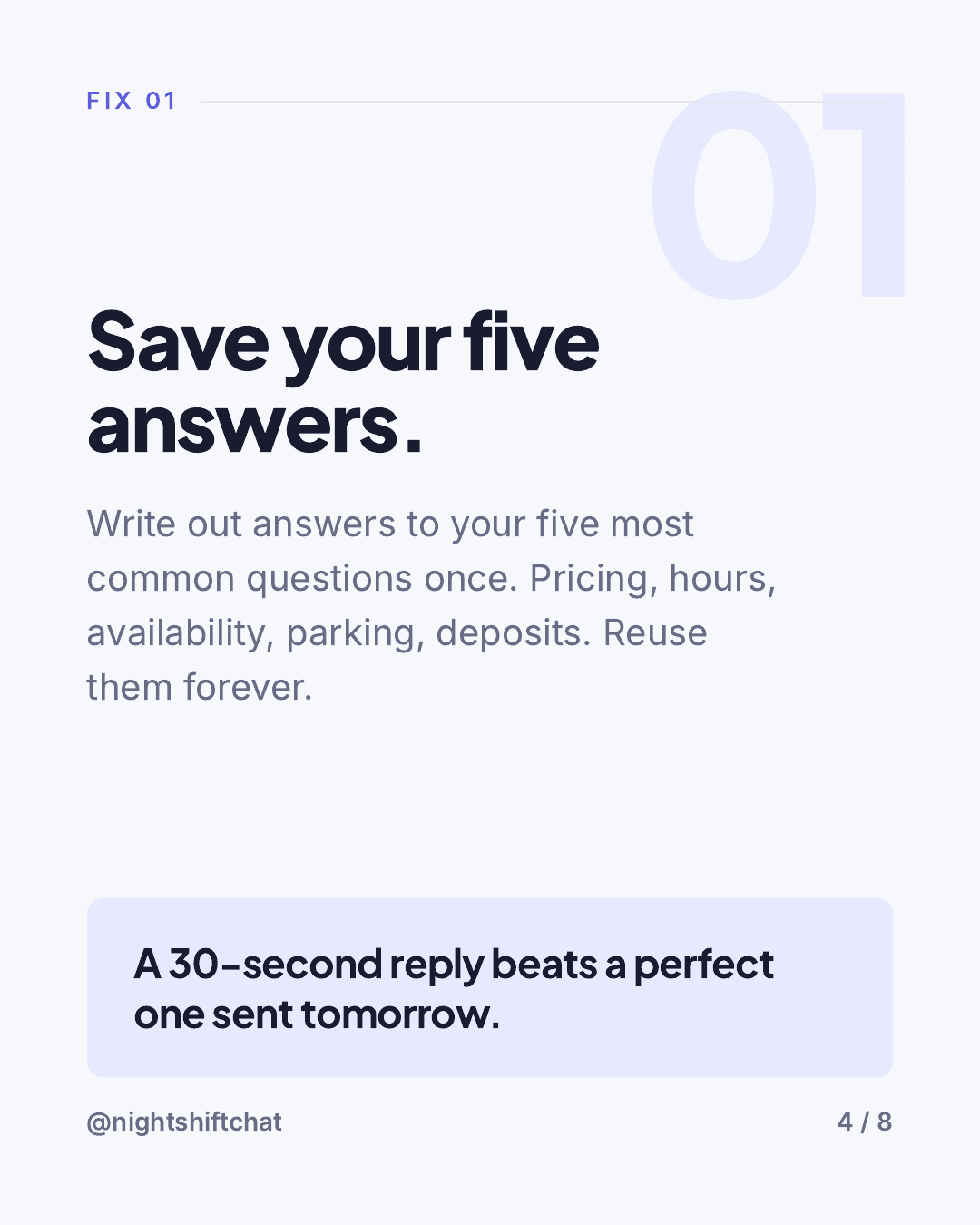
Saved replies. Write out answers to your five most common questions once: pricing, availability, hours, parking, deposits. Every phone and every social platform supports saved or quick replies. A 30-second templated reply, lightly personalised, beats a perfect reply sent tomorrow. It also beats the mental load of composing the same answer for the hundredth time.
Reply windows. Two fixed 10-minute blocks a day, for example midday and 5pm, outperform constant checking. Your average response time drops because replies actually happen, and your head stays in the work in between. Constant checking feels responsive but mostly produces half-read messages that get forgotten.
What about enquiries that arrive after hours?
After-hours enquiries need an answer path that works while you are off the clock, because a large share of customers research and message local businesses at night, after their own workday ends.
You have three options, in ascending order of effort and payoff. An instant auto-reply that sets expectations and links to online booking, so the customer can act immediately instead of waiting. A genuinely complete FAQ and pricing section on your website, so the answer is already there. Or an assistant on your website that answers questions from your own information in real time and takes the visitor's name and number, so the enquiry is sitting in your inbox at 7am instead of in a competitor's calendar. That last option is what we build at Nightshift, and it exists precisely because the first reply wins.
Whichever you choose, the principle is the same. Speed is not a personality trait. It is a system, and systems are things you can set up once.
Quick answers
How quickly should a business respond to a customer enquiry?
As close to instantly as possible. Research on lead response consistently shows that replying within minutes dramatically increases the chance of winning the customer, while waiting hours usually means they have already booked with a competitor.
Why do customers choose the first business that replies?
Most customers enquire with several businesses at once and treat response speed as a signal of reliability. A fast reply says the business is organised and wants the work. Silence reads as disinterest, even when the business simply had not seen the message yet.
How can a small business reply faster without more staff?
Three low-cost fixes: saved replies for the five most common questions, two fixed reply windows per day instead of constant checking, and an after-hours answer path such as an auto-reply with a booking link or a website assistant that responds instantly and captures the enquiry.